

Are supplements regulated in the UK?
Yes. In the UK, food supplements are regulated as food, not as medicines. In England the Food Supplements (England) Regulations 2003 set the labelling rules, health claims must come from the GB register, and local authority trading standards enforce the law. There is no licence for each product before sale, so the seller is responsible for safety and labelling.
Who regulates supplements in the UK?
Several bodies share the job, depending on whether the question is the product, the label, the claim or the advert.
| Body | Role | Go to them about |
|---|---|---|
| Department of Health and Social Care (England) | Sets food supplement policy and the law in England | The rules themselves |
| Food Standards Agency | Publishes guidance for businesses; policy lead in Northern Ireland | What a seller must do |
| Local authority trading standards and environmental health | Enforce food law and can take legal action | A product, its label or its safety |
| MHRA | Decides when a product is really a medicine | Products sold as treatments |
| ASA, applying the CAP Code | Enforces the advertising codes, including on brands' own websites and social media since March 2011 | Misleading adverts and claims |
Do supplements need approval before they are sold?
No. Unlike a medicine, a food supplement does not need a marketing authorisation before it goes on sale.
The business registers with its local authority as a food business and, the Food Standards Agency says, is responsible for making sure what it sells is safe. The label must, among other things:
- say "food supplement";
- give the recommended daily dose and a warning not to exceed it;
- say it should not replace a varied diet and should be kept out of the reach of young children;
- give the amount of each vitamin, mineral or other substance with a nutritional or physiological effect, with vitamins and minerals also shown as a %NRV.
The rules also ban suggesting that a varied diet cannot provide enough nutrients in general.
What health claims are supplements allowed to make?
Only claims on the Great Britain nutrition and health claims register, or wording that would mean the same to a shopper.
- The register lists every authorised and rejected claim; it was last updated on 19 May 2026.
- Claims are about named nutrients, such as zinc or vitamin C, at a level the register sets, not about a whole product.
- General phrases such as "good for you" are only allowed next to a specific authorised claim.
- No food, including a supplement, may claim to prevent, treat or cure a disease.
- A health claim may not refer to the recommendation of an individual doctor or health professional.
When does a supplement count as a medicine?
When it is presented as preventing or treating disease, or works by a pharmacological, immunological or metabolic action. The MHRA makes that call.
It looks at the claims, direct or implied, what the ingredients do, and how the product is presented on labels, websites, social media and in customer reviews. Herbal ingredients do not exempt a product.
What does batch testing for banned substances mean?
A laboratory has checked a batch for substances banned in sport. It is about contamination risk for athletes, not whether a product does anything.
One UK-based scheme is Informed Sport, run by LGC. It says it tests every batch of a certified product before release, and you can search its website by batch number. A one-off screening tells you about that batch only, so ask of any testing claim: which batch, and is every batch tested?
How can you check a supplement brand in 5 steps?
Five quick checks cover most of what matters.
- Look the company up on Companies House. Check the company on the label is real and active, and how old it is.
- Check the claims against the register. Health claims should read like the register's wording, nutrient first, with no promise to treat or fix anything.
- Check the amounts are listed. Vitamins and minerals should show an amount and a %NRV. See whether herbs and extracts have amounts or only names.
- Ask for the testing certificate. Find out who tested, for what, and which batch it covers.
- Read the returns and cancellation terms. Check how to cancel and whether opened products can be returned.
See also how to read a supplement label and how to choose an all-in-one supplement.
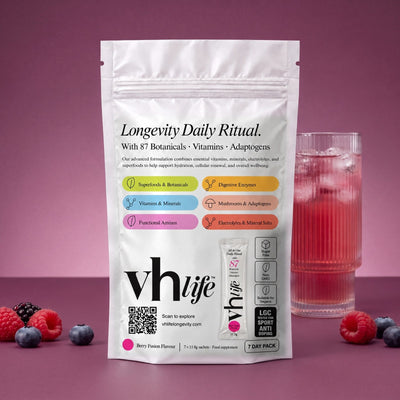
Where does VH Life fit? A worked example
The same 5 steps applied to VH Life, including the less flattering parts.
- Company. VH Life is made by Vita Hydra Life Ltd, Companies House number 16670178, registered in England and Wales. It is active and was incorporated on 26 August 2025, so it is a young company.
- Claims. We only use wording from the GB register, for nutrients present at 15% of the NRV or more in one sachet. For example, a sachet provides 15mg of zinc (150% NRV). Zinc contributes to normal cognitive function. We make no claim for the herbs, mushrooms, adaptogens, enzymes or live cultures, because no authorised claim exists for them.
- Amounts. The box gives amounts and %NRV for its 26 vitamins, minerals and other nutrients. The herbs, greens, mushrooms, amino acids, enzymes and live cultures are named on the box without amounts.
- Testing. A batch was screened for banned substances by LGC, a UK sports anti-doping laboratory. VH Life is not on the Informed Sport register, and the screening covers one batch, not every batch.
- Returns and cancelling. Unopened boxes can be returned within 30 days. Subscriptions can be paused or cancelled any time from your account.
On subscription VH Life is £49.99 for 28 sachets every 4 weeks, which works out at £1.79 a day. There is also a 7-day trial (7 sachets, £12.99, one per customer) and one box of 14 sachets for £34.99. You can check the VH Life label and nutrition table yourself, or read more about VH Life and who makes it.
Questions people also ask
Is the supplement industry unregulated in the UK?
No. Supplements are regulated as food: there are rules on composition, labelling and claims, and local authority trading standards enforce them. There is no licence for each product before sale, so it is still worth checking the label and the company yourself.
Are supplements checked for safety before they go on sale?
Not product by product. The business must register as a food business with its local authority and is legally responsible for selling safe food. Enforcement officers can act after a product is on sale, and the MHRA can step in if a product is presented as a medicine.
Who do I complain to about a supplement?
For a product, its label or its safety, contact your local authority's trading standards service. For a misleading advert, including on a brand's website or social media, the ASA. If a product is being sold as a treatment for a condition, the MHRA handles complaints about unlicensed medicines.
What does NRV mean on a supplement label?
NRV stands for nutrient reference value, a legal reference amount for each vitamin and mineral. A %NRV shows how much of that reference one serving gives. In general, 15% of the NRV per portion is the benchmark for a significant amount, which is also when a nutrient's health claims can be used.
Can a brand use a doctor to endorse its supplement?
Not alongside a health claim. UK rules ban health claims that refer to the recommendation of an individual doctor or health professional, so a brand cannot pair an expert endorsement with a nutrient claim in its marketing.
Sources
- legislation.gov.uk: The Food Supplements (England) Regulations 2003, regulation 6, accessed 21 October 2026.
- Food Standards Agency: Food supplements, guidance for businesses, accessed 21 October 2026.
- Department of Health and Social Care: Nutrition and health claims, guidance to compliance with Regulation (EC) 1924/2006, accessed 21 October 2026.
- GOV.UK: Great Britain nutrition and health claims (NHC) register, accessed 21 October 2026.
- MHRA: Borderline products, how to tell if your product is a medicine, accessed 21 October 2026.
- ASA and CAP: CAP Code section 15, food, food supplements and associated health or nutrition claims, accessed 21 October 2026.
- legislation.gov.uk: Regulation (EU) No 1169/2011, Annex XIII (nutrient reference values), accessed 21 October 2026.
- Informed Sport: About, accessed 21 October 2026.
- Companies House: VITA HYDRA LIFE LTD (16670178), accessed 21 October 2026.
Food supplements should not be used as a substitute for a varied and balanced diet and a healthy lifestyle. One sachet a day. Not suitable for children, adolescents, or pregnant or breastfeeding women. VH Life is a food supplement, not a medicine. If symptoms persist, see your GP or pharmacist.