

Should I take vitamin D in the UK, and how much?
Yes, for most people in the UK. The NHS advises everyone to consider a daily supplement of 10 micrograms (400 IU) of vitamin D in autumn and winter, when the sun is too weak to make enough. Some people should take 10 micrograms all year. Adults should not take more than 100 micrograms (4,000 IU) a day.
Should I take vitamin D in the summer?
Most people do not need to. The NHS says that from about late March or early April to the end of September, most people can make all the vitamin D they need from sunlight on their skin and a balanced diet, so you may choose not to take a supplement in those months.
Between October and early March the UK sun is not strong enough, so the advice for everyone, including pregnant and breastfeeding women, is to consider a daily 10 microgram supplement.
Who should take vitamin D all year round?
People who get little or no sun on their skin. The Department of Health and Social Care recommends a daily 10 microgram supplement throughout the year if you:
- are not often outdoors, for example if you are frail or housebound
- live in an institution such as a care home
- usually wear clothes that cover most of your skin when outdoors
The NHS adds that if you have dark skin, for example an African, African-Caribbean or south Asian background, you may not make enough vitamin D from sunlight and should consider 10 micrograms a day all year. Babies and children aged 1 to 4 have their own year-round advice, covered on the NHS vitamin D page.
How much vitamin D should I take a day?
For adults, 10 micrograms a day. The NHS says that if you choose to take a supplement, 10 micrograms a day will be enough for most people. One microgram is 40 IU, so 10 micrograms is 400 IU.
This figure comes from SACN, the government's Scientific Advisory Committee on Nutrition. In 2016 it set a reference nutrient intake of 10 micrograms a day for everyone aged 4 and over, from all sources combined: food, fortified food and supplements.
| Group | Daily amount the NHS advises | Do not take more than |
|---|---|---|
| Adults, including pregnant and breastfeeding women and older people | 10µg (400 IU) | 100µg (4,000 IU) |
| Children aged 11 to 17 | 10µg (400 IU) | 100µg (4,000 IU) |
| Children aged 1 to 10 | 10µg (400 IU) | 50µg (2,000 IU) |
| Babies under 12 months | 8.5 to 10µg | 25µg (1,000 IU) |
If a doctor has advised a different amount, follow their advice.
How much vitamin D is too much?
For adults, more than 100 micrograms (4,000 IU) a day. The NHS says taking too much vitamin D over a long period can cause calcium to build up in the body (hypercalcaemia), which can weaken the bones and damage the kidneys and the heart.
Some medical conditions mean people cannot safely take as much, so ask your doctor if unsure. You cannot overdose on vitamin D from sunlight.
The real risk is stacking products without noticing. A multivitamin, a separate vitamin D spray and a fortified drink can each carry vitamin D, so add up the micrograms on every label. Our guide to how many supplements to take a day shows how to do it.
Can I get enough vitamin D from food?
Usually not in winter. The NHS says vitamin D is found in only a small number of foods, which is why a supplement is advised from October to March. Sources include:
- oily fish, such as salmon, sardines, trout, herring and mackerel
- red meat
- egg yolks
- fortified foods, such as some fat spreads and breakfast cereals
- liver (avoid liver if you are pregnant)
In the UK, cows' milk is generally not a good source because it is not fortified, as it is in some other countries. If you are vegan, the NHS suggests fortified foods or a supplement containing vitamin D.
Where does VH Life fit?
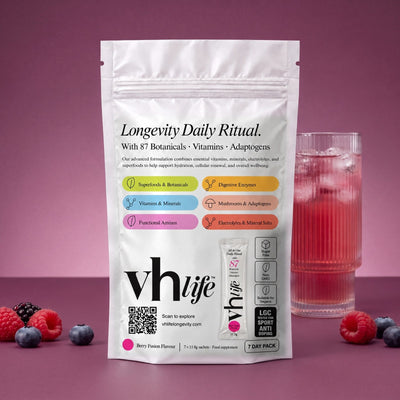
VH Life is a daily all-in-one sachet, not a vitamin D product, and if vitamin D is the only thing you want, a plain 10 microgram supplement is the simpler choice. If you are choosing VH Life for its wider mix of 26 vitamins and minerals, here is what it means for your vitamin D.
The box declares 62.5µg of vitamin D (2,500 IU, 1,250% NRV) per sachet.
That is above the 10 micrograms the NHS suggests for everyday use, and under the 100 microgram adult upper limit. If you already take a vitamin D supplement, add up the total. A 25µg tablet on top of a sachet gives 87.5µg, still under the limit. A 50µg tablet on top gives 112.5µg, which is over it. With 62.5µg in a sachet, do not add another vitamin D product unless a doctor advises it.
For the other nutrients in VH Life with an immune claim, see which vitamins and minerals have an authorised immune claim. VH Life is not suitable for children or for pregnant or breastfeeding women, who should follow the NHS advice above. The sachet also contains vitamin K (30µg), so if you take an anticoagulant or antiplatelet medicine, ask your doctor before use.
On subscription VH Life is £49.99 for 28 sachets every 4 weeks, which works out at £1.79 a day. You can also try a 7-day trial (7 sachets, £12.99, one per customer) or buy one box of 14 sachets for £34.99. Free UK delivery. Read the VH Life sachet's full nutrition label before you decide.
Questions people also ask
Should I take vitamin D everyday?
In autumn and winter, yes, the NHS advises everyone to consider 10 micrograms a day. From about April to September most people make enough from sunlight. If you are rarely outdoors, cover most of your skin, or have dark skin, the NHS advises 10 micrograms a day all year.
Should I take vitamin D in the morning or at night?
The NHS guidance does not set a time of day. It sets the amount: 10 micrograms a day for most people, and no more than 100 micrograms for adults. Take it at a time you will remember, and follow the directions on your product's label.
Is 2,500 IU of vitamin D a day too much?
For adults it is under the NHS upper limit of 4,000 IU (100 micrograms) a day, but well above the 400 IU (10 micrograms) the NHS says is enough for most people. The risk comes from adding several products together, so check every label and keep your total under 4,000 IU.
Should I take vitamin D with K2?
The NHS vitamin D guidance does not advise taking vitamin K2 alongside it, and sets no combined dose. If you take a product containing vitamin K and you are on an anticoagulant such as warfarin, or an antiplatelet medicine, ask your doctor or pharmacist first.
Is a multivitamin enough vitamin D?
It depends on the label. To follow the NHS autumn and winter advice, a product needs to give at least 10 micrograms (400 IU) a day. Check the amount per daily dose, not per tablet. Our guide to whether you need a multivitamin explains what else to check.
Can I get vitamin D from the sun in winter?
Not enough in the UK. The NHS says that between October and early March we do not make enough vitamin D from sunlight, which is why a daily 10 microgram supplement is advised for everyone in those months.
Sources
- NHS: Vitamin D, accessed 21 October 2026.
- GOV.UK: SACN vitamin D and health report, accessed 21 October 2026.
- NHS: The vegan diet, accessed 21 October 2026.
- GOV.UK: Great Britain nutrition and health claims (NHC) register, accessed 21 October 2026.
One sachet a day. Food supplements should not be used as a substitute for a varied and balanced diet and a healthy lifestyle. Not suitable for children, adolescents, or pregnant or breastfeeding women. VH Life is a food supplement, not a medicine. If symptoms persist, see your GP or pharmacist.