

What is the best all-in-one supplement in the UK?
There is no single best all-in-one supplement in the UK, because the right one depends on your diet, budget and what you already take. Judge any product on its amounts against the NRV, its vitamin D level, what it leaves out, testing, where it is made, price per serving on the plan you will keep, and its format.
Are all in one supplements good?
They can be a convenient way to take several vitamins and minerals in one go, but they are not a substitute for food. The NHS says most people should get the nutrients they need from a varied and balanced diet, although some people need extra supplements.
"All-in-one" has no legal meaning. It can describe a multivitamin tablet, a greens powder or a sachet with vitamins, minerals and plant ingredients. Our explainer on what an all-in-one daily supplement is covers the basics.
What should you check before you buy an all-in-one supplement?
Seven things, most of them on the label or the terms page.
- Amounts per serving against the NRV. Each vitamin and mineral should show an amount and a %NRV; in law, 15% of the NRV per portion is the usual benchmark for a "significant amount". Then check the high end against the NHS levels unlikely to cause harm: less than 1,000mg of vitamin C, no more than 25mg of zinc unless a doctor advises it, 0.9mg or less of biotin, and 4mg or less of manganese for most people (0.5mg or less for older people). VH Life, for example, has 1,000µg of biotin, above that NHS biotin level, and 3mg of manganese.
- The vitamin D level. The NHS suggests adults consider 10µg daily in autumn and winter and says not to take more than 100µg daily. Add up vitamin D from every product you take.
- What is not in it. Many all-in-ones leave out iron and omega-3, and some contain little calcium. Iron needs vary: the NHS gives 14.8mg daily for women aged 19 to 49 and 8.7mg for men and for women aged 50 and over.
- Testing. Ask what was tested (banned substances in sport, contaminants) and whether the certificate covers every batch or one batch.
- Where it is made. UK-made or imported, and where it ships from, affects delivery and returns.
- Price per serving on the plan you would actually use, and how you cancel. Use the recurring price, not the first-order offer, and read the cancellation terms before you subscribe.
- Format and taste. Tablets, a scoop or sachets. A small trial size tells you whether you will keep taking it.
Our guide to how to read a supplement label goes through points 1 to 3 step by step.
How do multivitamin tablets, greens powders and all-in-one sachets compare?
A multivitamin tablet is usually the cheapest. Greens powders and all-in-one sachets cost more and add plant and other ingredients.
| Format | What it typically contains | Example cost per serving | What to watch for |
|---|---|---|---|
| Multivitamin tablet | Vitamins and minerals, often near 100% NRV; many include iron | 3.5p: Holland & Barrett Multivitamins, £8.29 for 240 tablets (21 October 2026) | No plant ingredients; check iron if you do not need it |
| Greens powder | Dried vegetables, fruit and grasses; some add vitamins, probiotics or enzymes | £2.63: AG1 on subscription (9 October 2026) | Some list few vitamin amounts; ingredients may be named without amounts |
| All-in-one sachet or powder | Vitamins and minerals with amounts, plus plant extracts, mushrooms, amino acids, enzymes or cultures | £2.97: IM8 on subscription (9 October 2026). VH Life: £1.79 a day on the £49.99 plan of 28 sachets every 4 weeks | Often no iron or omega-3; plant ingredient amounts may be missing |
For more detail on the first two, see multivitamin vs greens powder, and for 10 powders priced per serving, see our AG1 alternatives table.
Where does VH Life fit?
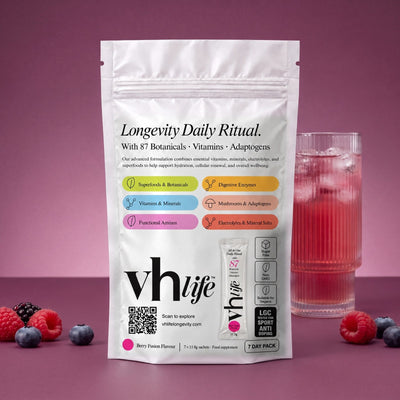
VH Life sits in the last row of the format table: one option, not the answer for everyone. It is a UK-made food supplement, one 11.8g berry sachet daily in cold water, with 87 active ingredients.
The box declares amounts and %NRV for its 26 vitamins, minerals and other nutrients. The herbs, greens, mushrooms, amino acids, enzymes and live cultures are named without amounts, and no authorised health claim exists for them, so we make none. It has no iron, no omega-3, no protein and no collagen, and calcium is 164mg (20.5% NRV). A batch was screened for banned substances by LGC, a UK sports anti-doping laboratory.
| Nutrient | Per sachet | %NRV | Authorised claim |
|---|---|---|---|
| Vitamin C | 900mg | 1,125% | Vitamin C contributes to the reduction of tiredness and fatigue. |
| Vitamin B12 | 250µg | well above 15% of the NRV | Vitamin B12 contributes to normal energy-yielding metabolism. |
| Zinc | 15mg | 150% | Zinc contributes to normal cognitive function. |
| Magnesium | 65mg | 17.3% | Magnesium contributes to normal muscle function. |
| Iodine | 150µg | 100% | Iodine contributes to the normal production of thyroid hormones and normal thyroid function. |
62.5µg is above the NHS everyday suggestion of 10µg and under the 100µg upper limit; if you already take vitamin D, add up the total. Biotin at 1,000µg can interfere with some blood tests, including thyroid tests. People on anticoagulant or antiplatelet medicines should ask their doctor before use, because it contains vitamin K.
On subscription VH Life is £49.99 for 28 sachets every 4 weeks, which works out at £1.79 a day. There is also a 7-day trial (7 sachets, £12.99, one per customer) and one box of 14 sachets for £34.99, with free UK delivery. You can read the full VH Life label and plans on the product page.
Questions people also ask
What is the one supplement everyone should take?
In the UK, the NHS says everyone should consider a daily 10µg vitamin D supplement during autumn and winter, and some people throughout the year. Beyond that, it says most people should get the nutrients they need from a varied and balanced diet. See our vitamin D guide.
Is an all-in-one supplement better than a multivitamin?
Not automatically. A multivitamin tablet covers vitamins and minerals for far less per serving. An all-in-one adds plant and other ingredients in a drink, and costs more. If vitamins and minerals are all you want, a tablet is the cheaper choice.
Is there a best all-in-one supplement for women or men over 40?
No single product. Needs differ: the NHS gives 14.8mg of iron daily for women aged 19 to 49 and 8.7mg for men and for women aged 50 and over. Use the same checklist, and check iron, vitamin D and anything you already take.
Can I take an all-in-one supplement with a multivitamin?
Usually there is no need, and it can double some doses. If you do, add up each nutrient across both products and compare it with the NHS guidance, for example no more than 100µg of vitamin D and no more than 25mg of zinc from supplements unless a doctor advises it.
What supplements should I take in the UK?
For most adults the NHS suggests considering 10µg of vitamin D daily in autumn and winter. Other supplements depend on your diet and circumstances, so if you think you are low in something, ask your GP or pharmacist. Our guide on whether you need a multivitamin goes through it.
Sources
- NHS: Vitamins and minerals, accessed 21 October 2026.
- NHS: Vitamin D, accessed 21 October 2026.
- NHS: Iron, accessed 21 October 2026.
- NHS: Vitamin C, accessed 21 October 2026.
- NHS: B vitamins and folic acid, accessed 21 October 2026.
- NHS: Others (minerals including manganese and zinc), accessed 21 October 2026.
- legislation.gov.uk: Regulation (EU) No 1169/2011, Annex XIII (nutrient reference values), accessed 21 October 2026.
- legislation.gov.uk: The Food Supplements (England) Regulations 2003, regulation 6, accessed 21 October 2026.
- MHRA: Safety Roundup, May 2025 (biotin and thyroid tests), accessed 21 October 2026.
- GOV.UK: Great Britain nutrition and health claims (NHC) register, accessed 21 October 2026.
- Holland & Barrett: Multivitamins, accessed 21 October 2026.
- AG1: AG1 Pouch, UK product page, prices checked 9 October 2026.
- IM8: Daily Ultimate Essentials Pro, UK page, accessed 21 October 2026.
Food supplements should not be used as a substitute for a varied and balanced diet and a healthy lifestyle. One sachet a day. Not suitable for children, adolescents, or pregnant or breastfeeding women. VH Life is a food supplement, not a medicine. If symptoms persist, see your GP or pharmacist.