

Are greens powders worth it, or a waste of money?
For most people who already eat their 5 A Day, a greens powder adds little, and it never replaces vegetables. No authorised health claim exists for greens such as spirulina, chlorella or wheatgrass in the UK. A powder can still be worth it if you value the habit, the label declares amounts and the price per serving suits you.
What is actually in a greens powder?
Usually a mix of dried plant ingredients, and sometimes a lot more. The common building blocks are:
- Grasses, such as wheatgrass and barley grass.
- Algae, such as spirulina and chlorella.
- Vegetable and fruit powders, such as spinach, kale, beetroot or berries.
- Added extras: fibre such as inulin, digestive enzymes, live cultures, mushrooms or herbs.
- In some products, added vitamins and minerals with declared amounts.
Two "greens powders" can be very different products, from mostly plant powders to something closer to a multivitamin. The label is the only way to tell.
Do greens powders actually do anything?
For the greens themselves, no authorised UK health claim exists. The GB Nutrition and Health Claims Register has no authorised claim for spirulina, chlorella or wheatgrass, and no probiotic claim. Its only enzyme and culture claims are narrow lactose-digestion claims with strict conditions. So no brand can point to an authorised gut, energy or immunity claim for its greens.
An authorised health claim on a greens powder will almost always belong to a vitamin or mineral in it, at a meaningful amount (at least 15% of the NRV in a serving). The claim belongs to the nutrient, not the greens.
We could not find an NHS or NICE page that recommends greens powders. What the NHS does recommend is plenty of varied fruit and vegetables, which is where the next question comes in.
Is greens powder a good substitute for vegetables?
No. The NHS advises at least 5 portions of a variety of fruit and vegetables a day, at 80g a portion. Fresh, frozen, tinned, dried and juiced all count. Powders and supplements are not among the forms it lists.
Fibre is part of the reason. The NHS says government guidelines are 30g of fibre a day and that most adults get about 20g. Check how many grams of fibre a powder gives per serving before you treat it as a fix for that gap. For the fuller comparison with tablets, read multivitamin vs greens powder vs all-in-one.
What should I look for in a greens powder?
Read the label before the marketing.
| Check | What to look for | Why it matters |
|---|---|---|
| Declared amounts | A number per serving next to each ingredient you care about | A blend with only a total weight tells you little about any single ingredient |
| Testing | Batch testing for banned substances if you compete in sport, and the name of the lab | "Tested" alone says nothing about what or by whom |
| Price per serving | Pack price divided by the number of servings | Pack sizes vary |
| Sweetener | Which sweetener is used, if any | The NHS advises people with IBS to avoid products containing the sweetener sorbitol |
| Vitamin doses | Amounts compared with NHS guidance on how much is too much | The NHS says more than 1,000mg of vitamin C a day can cause stomach pain, diarrhoea and wind |
If you also take a multivitamin, add the two labels together so you stay within NHS guidance.
Why do greens powders make some people feel sick?
Often because of how they are taken, rather than anything wrong with the product. Drinking a concentrated powder on an empty stomach, starting at a full serving, fermentable fibre and some sweeteners are the usual suspects.
High doses can play a part. The NHS lists feeling sick among the side effects of high-dose iron (over 20mg), and stomach pain and diarrhoea among the effects of more than 1,000mg of vitamin C a day. Our guide on why greens powders make some people feel sick covers what to change. If you get swelling, wheezing or a rash, stop and get medical help. If stomach upset carries on, stop and speak to a GP or pharmacist.
Where does VH Life fit?
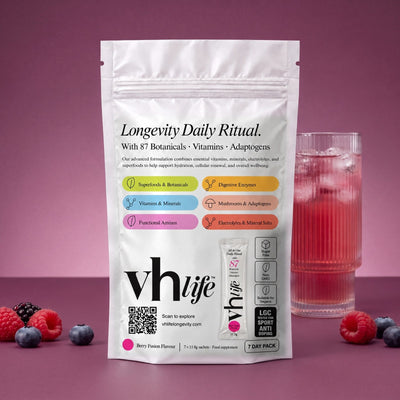
VH Life is not a greens powder. It is an all-in-one: one 11.8g berry sachet a day with 87 active ingredients. Its 26 vitamins and minerals have declared amounts. Its greens, herbs, mushrooms, amino acids, enzymes and live cultures are named on the box without individual amounts, and because no authorised health claim exists for them, we make none.
A few of the declared amounts, each above 15% of the NRV in one sachet:
- Vitamin C 900mg (1,125% NRV), which is under the NHS 1,000mg figure. Vitamin C contributes to the normal function of the immune system.
- Zinc 15mg (150% NRV). Zinc contributes to the protection of cells from oxidative stress.
- Calcium 164mg (20.5% NRV). Calcium contributes to the normal function of digestive enzymes.
It is sweetened with steviol glycosides, is sugar free, suitable for vegans and made in the UK. A batch was screened for banned substances by LGC, a UK sports anti-doping laboratory. It has no iron, no omega-3, no protein and no collagen, and it does not count towards your 5 A Day.
It suits someone who wants vitamins and minerals with known amounts plus plant ingredients in one drink, not someone who wants every plant ingredient measured or the lowest-cost option. On subscription VH Life is £49.99 for 28 sachets every 4 weeks, which works out at £1.79 a day. There is also a 7-day trial (7 sachets, £12.99, one per customer) and one box of 14 sachets for £34.99, with free UK delivery. See the VH Life Berry label and plans or compare it with AG1 alternatives in the UK.
Questions people also ask
What about greens powders and bloating?
No authorised claim exists for bloating, for greens or for probiotic cultures in supplements, so be wary of any greens powder that promises to relieve it. Some ingredients can make it worse: the NHS advises people with IBS to avoid the sweetener sorbitol to ease bloating. For what the NHS suggests instead, read our guide to bloating.
How much does a greens powder cost in the UK?
It varies a lot by brand and plan, so work it out per serving: the pack price divided by the number of servings. Our AG1 alternatives page compares prices for the main UK options, and the supplement cost per day guide compares formats.
How long before a greens powder does anything?
No brand can point to an authorised claim for the greens, so be wary of promised timelines. Any claim on the label belongs to a vitamin or mineral in it. Our guide to how long a supplement takes to work explains what you can and cannot expect.
Is greens powder safe during pregnancy?
Ask your midwife or GP before taking any greens or all-in-one powder while pregnant or breastfeeding. Many contain herbs, mushrooms or high-dose vitamins, so get advice first. VH Life is not suitable for pregnant or breastfeeding women.
Is a greens powder a waste of money?
It can be, if it replaces vegetables or if you cannot tell what is in it. It is better value when the label gives amounts, the price per serving is clear and you would otherwise buy several products. Spend on fruit and vegetables first.
Do I need a greens powder if I take a multivitamin?
Not for vitamins and minerals, if your multivitamin already covers them. A greens powder mainly adds plant powders, for which no authorised health claim exists. If you take both, add up the vitamin and mineral totals on the two labels so you stay within NHS guidance.
Sources
- NHS: Why 5 A Day?, accessed 21 October 2026.
- NHS: 5 A Day: what counts?, accessed 21 October 2026.
- NHS: How to get more fibre into your diet, accessed 21 October 2026.
- NHS: Diet, lifestyle and medicines for irritable bowel syndrome (IBS), accessed 21 October 2026.
- NHS: Vitamin C, accessed 21 October 2026.
- NHS: Iron, accessed 21 October 2026.
- GOV.UK: Great Britain nutrition and health claims (NHC) register, accessed 21 October 2026.
Food supplements should not be used as a substitute for a varied and balanced diet and a healthy lifestyle. One sachet a day. Not suitable for children, adolescents, or pregnant or breastfeeding women. VH Life is a food supplement, not a medicine. If symptoms persist, see your GP or pharmacist.